

Timers for Home, Garden & Electrical Control
Compare timers for lighting, appliances, outlets, irrigation, and other scheduled tasks. Review timer types, programming options, compatibility, and safety features before choosing.
44 products in catalog
44 results
Filters


![[2 Pack] BESTTEN Weatherproof Outdoor Plug-in Photocell Timer Switch with 2 Grounded Outlets, Light Sensor and Dusk to Dawn Countdown Timer, for Christmas Decorations, Black, ETL Listed](https://m.media-amazon.com/images/I/61UAwKDNO-L._AC_SL1200_.jpg)
![[2 Pack] BESTTEN Weatherproof Outdoor Plug-in Photocell Timer Switch with 2 Grounded Outlets, Light Sensor and Dusk to Dawn Countdown Timer, for Christmas Decorations, Green, ETL Listed](https://m.media-amazon.com/images/I/71CFl+9yKLL._AC_SL1200_.jpg)

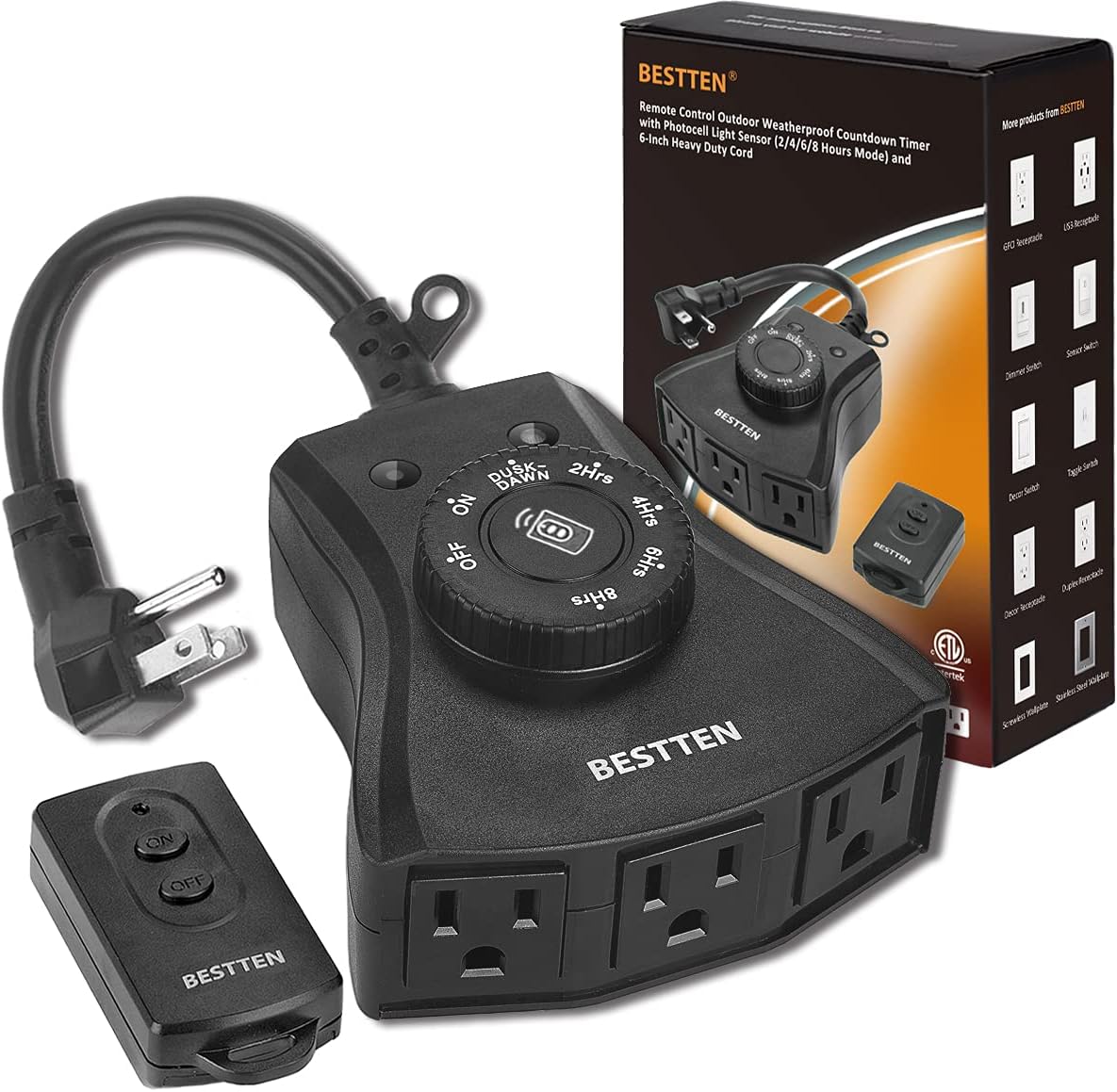


![[2 Pack] BESTTEN Outdoor 24-Hour Timer, Weatherproof, Grounded Outlet, Heavy Duty 6-Inch Power Cord, Flat Plug, for Holiday Decoration, ETL Certified](https://m.media-amazon.com/images/I/61W32JOpcaL._AC_SL1200_.jpg)


Popular brands in Timers
Timers help automate electrical devices, lighting, appliances, and watering systems by turning them on or off according to a schedule. The right choice depends on where the timer will be used, what it controls, and how much programming flexibility is needed.
This K-Catalog page brings together timer products from brands including DEWENWILS, BESTTEN, BN-LINK, Intermatic, Melnor, Woods, Jasco Products Company, LLC, Eva zzy, Nelson, Plusmart, NSI, and BRINKS. Compare the listed specifications and features, then check the current product details on Amazon before buying.
How to choose a timer
Start by identifying the device or system the timer will control. A plug-in timer may suit a lamp, seasonal display, fan, or small appliance, while an in-wall model is more appropriate for a permanently installed lighting circuit. Garden timers are designed around hose or irrigation connections and need to match the watering setup.
Consider these questions before comparing models:
- Where will it be installed? Indoor and outdoor environments have different enclosure and weather-resistance requirements.
- What will it control? Check the timer’s supported load, voltage, amperage, and outlet or connection type.
- How often should it run? Simple repeating schedules may need only basic controls, while changing routines call for programmable settings.
- How will it be operated? Physical dials and buttons are straightforward; digital displays may offer more precise scheduling.
- What happens after a power interruption? Look for information about memory retention, reset behavior, and whether the schedule must be entered again.
If the timer will be connected to a larger electrical setup, related Cords, Adapters & Multi-Outlets may help with connection planning. For fixed installations, also compare Switches & Dimmers and Outlets & Accessories.
Common timer types
Plug-in outlet timers
Plug-in timers are generally convenient for lamps, holiday lighting, fans, and other compatible devices. They install between the wall outlet and the load, so they usually avoid rewiring. Compare the number and arrangement of outlets, plug clearance, manual override controls, and whether the design blocks neighboring receptacles.
Digital programmable timers
Digital timers are useful when a schedule needs more detail than a basic repeating dial can provide. Compare the display, controls, schedule options, backup or memory features, and ease of programming. A clear interface matters if the timer will be adjusted regularly.
Mechanical timers
Mechanical models use a dial or movable tabs to set operating periods. They can be a practical choice for straightforward recurring schedules. Check the smallest available time increment, dial visibility, manual control, and whether the timer is compatible with the intended load.
In-wall timers
In-wall timers replace or work alongside a wall switch and can provide a cleaner permanent installation. Compatibility is especially important: check wiring requirements, neutral-wire requirements if listed, switch or load type, electrical-box fit, and whether professional installation may be appropriate.
Watering timers
Water timers are intended for hoses, sprinklers, or irrigation connections. Melnor and Nelson are among the brands represented in the catalog. Compare connection size, outlet configuration, schedule controls, water-pressure guidance, battery requirements, and outdoor durability.
Features and specifications to compare
The most important specifications vary by application, but these details can help narrow the selection:
- Load capacity: Confirm that the timer can safely handle the connected device, including motor or lighting loads where applicable.
- Voltage and connection: Match the timer to the electrical system, plug style, receptacle, hose connection, or wiring arrangement.
- Scheduling: Look for the type of repeat cycle, number of programmable events, weekday selection, seasonal adjustment, or countdown function that fits the routine.
- Manual override: A temporary on/off control is useful when the schedule should be bypassed without deleting it.
- Outdoor protection: For exterior use, review weather resistance, enclosure details, and placement instructions rather than assuming an indoor timer is suitable outdoors.
- Power source: Digital and water timers may use batteries, while plug-in and in-wall products draw power from the connected electrical system. Check battery access and replacement requirements where relevant.
- Display and controls: Large labels, readable indicators, and accessible buttons can make setup easier, especially in dim or hard-to-reach locations.
For installation finishing pieces, browse Wall Plates & Accessories. If you need to verify an electrical connection or circuit separately, Testers are a related category to consider.
Brands represented in the catalog
The catalog includes timers from DEWENWILS, BESTTEN, BN-LINK, Intermatic, Melnor, Woods, Jasco Products Company, LLC, Eva zzy, Nelson, Plusmart, NSI, and BRINKS. Brand selection can help organize a comparison, but the timer’s specifications should remain the deciding factor. Check each listing for installation requirements, supported loads, controls, included components, and intended environment.
Installation and safety considerations
Follow the product instructions and confirm compatibility before connecting a timer. Do not exceed the stated electrical load, use an indoor-only model outdoors, or place an outdoor device where its protection does not match the exposure. Keep connections dry when required, route cords to avoid trip hazards, and make sure plugs and receptacles are fully seated.
For an in-wall timer, turn off power at the appropriate circuit and verify that the wiring arrangement matches the product requirements. If the installation is uncertain, consult a qualified electrician. For watering timers, check for leaks after installation and protect the unit from conditions not covered by its instructions.
Frequently asked questions
What can a timer control?
A compatible timer can control items such as lamps, lighting, appliances, fans, outdoor displays, or watering equipment. Always compare the timer’s load and connection specifications with the device.
Are plug-in timers easier to install than in-wall timers?
Usually, plug-in models require less installation because they connect between an outlet and a device. In-wall timers require wiring and must match the electrical box and circuit.
Should an outdoor timer be weather-resistant?
Yes. Outdoor use calls for a product specifically designed and labeled for the intended exposure. Review enclosure and placement instructions before installation.
What is the difference between mechanical and digital timers?
Mechanical timers typically use a dial or tabs for recurring control. Digital timers use electronic controls and may offer more detailed schedules, displays, and memory features.
What should be checked before buying a watering timer?
Check the hose or irrigation connection, outlet arrangement, schedule controls, water-pressure guidance, power source, and outdoor-use information.