

Ballasts for Electrical Lighting Systems
Compare ballasts for compatible lighting systems by lamp type, electrical requirements, starting method, and installation details. Review catalog specifications before choosing a replacement.
62 products in catalog
62 results
Filters


Universal Lighting
Universal Lighting Technologies B234SR120M-A000I Electronic Ballast, Fluorescent, T12, 2-Lamp, 120V, Black
See current price


Keystone Meats
Keystone Ballasts 22 & 32 Watt or 32 & 40 Watt circline, 120V, w/sockets, ELECTRONIC model number KTEB-2C72-1-TP-WS-CP
See current price


InterGlobal
InterGlobal IG13-20EL Magnetic Fluorescent Ballast, 1-Lamp, T8 F20T8, 20W, 120V
See current price


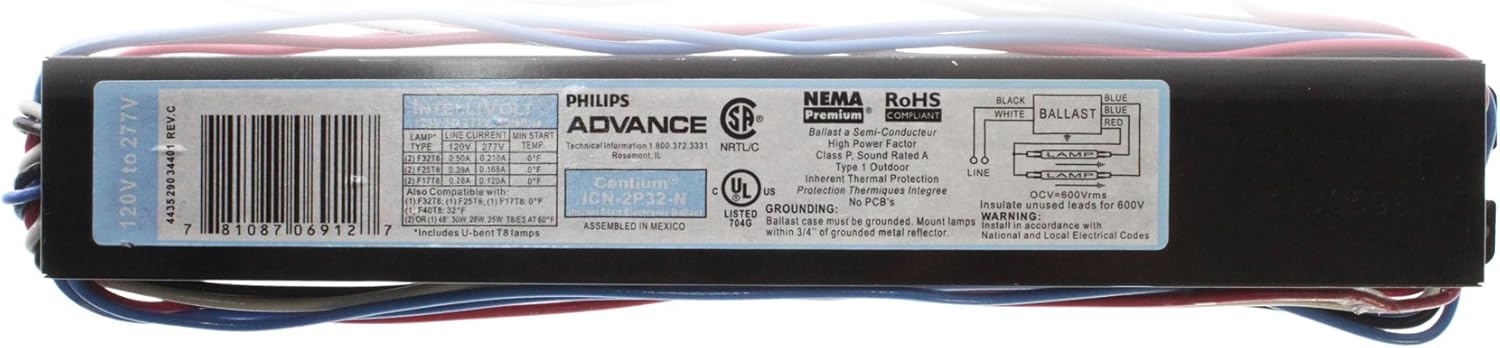
Philips
Philips Advance ICN-2P32-N 32W T8, 120/277V Electronic Fluorescent Ballast, 2 Lamp
See current price
Philips
Philips Advance ICN-2P32-N 32W T8, 120/277V Electronic Fluorescent Ballast, 2 Lamp
See current price

Philips
Philips Advance ICN-2P32-N 32W T8, 120/277V Electronic Fluorescent Ballast, 2 Lamp
See current price
Popular brands in Ballasts
Ballasts regulate the electrical current supplied to certain lighting systems, helping compatible lamps start and operate properly. The right replacement depends on the fixture, lamp technology, wiring, and electrical supply—not simply the ballast’s physical size.
K-Catalog brings together ballast listings from brands such as Philips, Keystone Technologies, Robertson Worldwide, VIVOSUN, Sylvania, Sunpark Electronics, KEYSTONE, OSRAM, Park & Sun, TCP, Solus, and GELIL. Use the listed specifications and features to compare suitable options before checking the current product details on Amazon.
How to choose a ballast
Start with the lighting system rather than the ballast alone. Identify the fixture and lamp it is designed to support, then compare the replacement’s electrical and installation requirements.
Important details include:
- Lamp compatibility: Confirm the ballast is intended for the exact lamp type, technology, wattage range, and lamp configuration.
- Input voltage: The ballast must match the electrical supply and fixture wiring. A physically compatible part may still be unsuitable if its input requirements differ.
- Starting method: Instant-start, rapid-start, and programmed-start designs can have different wiring and performance characteristics.
- Output and lamp count: Check how many lamps the ballast supports and whether the output specifications align with the fixture.
- Dimming capability: If the fixture uses a dimmer or lighting control, confirm that the ballast is rated for that application.
- Physical fit: Compare dimensions, mounting points, terminals, and wire connections before installation.
Ballast types and applications
Ballasts are commonly differentiated by the lamp and fixture they serve. Fluorescent ballasts are designed for compatible fluorescent lamps and may vary by starting method, lamp arrangement, and control features. Electronic designs are often selected for modern fluorescent fixtures, while magnetic designs may be used where the fixture and replacement requirements call for them.
Some listings may be intended for high-intensity discharge lighting or other specialized applications. These products should not be treated as interchangeable with fluorescent ballasts. Read the product specifications carefully and match the ballast to the lamp family and fixture design.
For LED conversions, do not assume that an existing ballast is required or compatible. Some LED lamps are ballast-compatible, while others require ballast bypass wiring or a dedicated LED driver. Follow the lamp manufacturer’s compatibility information and the ballast installation instructions.
Specifications to compare
The most useful comparison is between the information on the existing ballast, the fixture label, and the candidate product listing. Look for the following details:
- Supported lamp type and lamp designation
- Number of lamps and fixture configuration
- Input voltage and electrical frequency
- Starting method and ballast factor, where provided
- Rated operating temperature or fixture environment
- Dimming or control compatibility
- Wiring diagram, terminal style, and lead configuration
- Housing dimensions and mounting arrangement
- Certifications or compliance information stated in the listing
A replacement with similar dimensions is not necessarily an electrical match. If the original label is unreadable, consult the fixture documentation or have a qualified electrician identify the correct replacement.
Installation and safety considerations
Ballast replacement involves mains electricity and may require access inside a light fixture. Turn off power at the appropriate disconnect before inspection or installation, and verify that the circuit is de-energized with a suitable tester. Do not rely solely on a wall switch.
Follow the product wiring diagram exactly. Existing wiring, lamp sockets, and insulation should be inspected for heat damage or deterioration before a new ballast is installed. A ballast that hums, overheats, trips protection, or causes inconsistent starting may indicate a compatibility or wiring problem and should be addressed rather than ignored.
When a project also involves controls or surrounding electrical hardware, browse Switches & Dimmers, Testers, and Outlets & Accessories for related catalog options. Cords, Adapters & Multi-Outlets may also be relevant for portable or connected equipment, but these products do not replace proper fixture wiring.
Brands represented in the catalog
The Ballasts catalog includes products from Philips, Keystone Technologies, Robertson Worldwide, VIVOSUN, Sylvania, Sunpark Electronics, KEYSTONE, OSRAM, Park & Sun, TCP, Solus, and GELIL. Brand availability can vary by product type, so compare each listing’s compatibility information, specifications, wiring details, and intended application rather than selecting by brand name alone.
For related finishing and installation components, see Wall Plates & Accessories. Door Chimes & Bells is another nearby electrical category, although those products serve a different purpose from lighting ballasts.
Frequently asked questions
What does a ballast do?
A ballast regulates current and helps a compatible lamp start and operate within its intended electrical range. The correct design depends on the lamp and fixture.
Can any ballast replace an existing ballast?
No. The replacement must match the lamp type, lamp configuration, input voltage, starting method, wiring, and physical installation requirements.
Are electronic and magnetic ballasts interchangeable?
Not necessarily. They can differ in wiring, operating characteristics, lamp compatibility, and fixture requirements. Check the product documentation before choosing one.
Can a ballast be used with an LED lamp?
Only when the LED lamp is specifically rated for that ballast and installation method. Other LED products may require ballast bypass wiring or a dedicated driver.
Should ballast replacement be done by a professional?
If the work involves unfamiliar wiring, high-voltage circuits, damaged components, or uncertainty about compatibility, use a qualified electrician. Always follow applicable electrical requirements and the manufacturer’s instructions.