

Springs for Industrial Power Transmission
Compare springs for replacement, repair, and equipment design by load requirements, dimensions, material, and mounting needs. Review specifications and features to find a suitable option.
31 products in catalog
31 results
Filters

Prime-Line Products (Home Improvement)
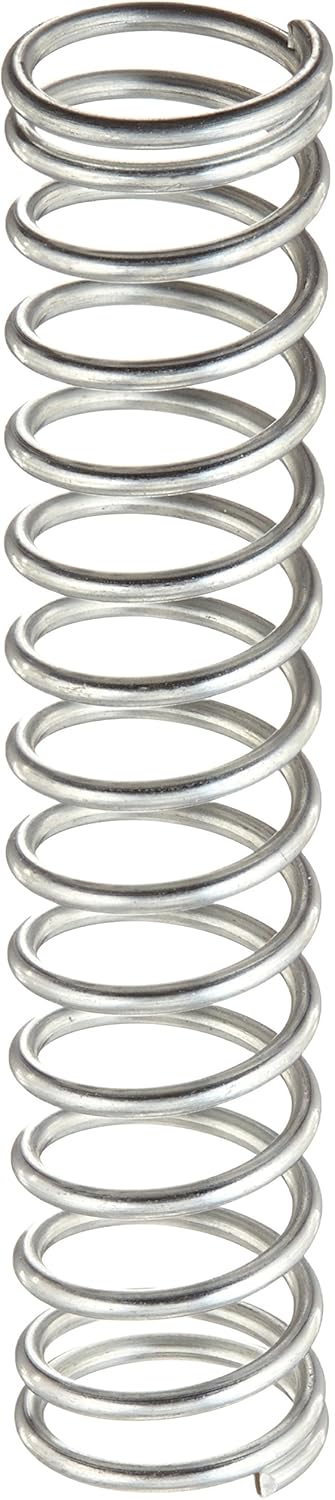
Handyman SP 9725 Compression Spring, Spring Steel Construction, Nickel-Plated Finish, 0.035 GA x 3/8 inch x 1-3/4 inch, (4-Pack)
See current price


Hardware Essentials
Hardware Essentials 852143 Galvanized Winding Rods for Torsion Springs, 18-Inch
See current price


Glarks
Glarks 200Pcs Zinc Plated Extension and Compression Industry Spring Assortment Kit
See current price

Muzerdo
200 Piece Muzerdo Spring Assortment Set | Zinc Plated Compression and Extension Springs
See current price


Auto Body Now
ABN Compression & Extension Spring 200 pc Assortment Set, Heavy-Duty Steel Wire – Metal Tension Springs Replacement Kit
See current price


National Hardware
National Hardware N280-362 V7618 Torsion Spring Lift Cables in Galvanized, 2 pack,8'8" x 1/8"
See current price


Swordfish Tools Inc.
SWORDFISH 32030 114pc Black Oxide Finish Compression Spring Assortment
See current price

Popular brands in Springs
Springs store and release mechanical energy, return components to position, apply tension or compression, and help manage movement in machinery. Choosing the right spring depends on how it will be loaded, the space available, the environment, and the required working life.
This K-Catalog selection sits within Power Transmission Products, making it useful for comparing spring options alongside other components used in mechanical systems. Product specifications can help narrow the choices before checking current availability and purchase details on Amazon.
How to choose a spring
Start with the motion and force the spring must provide. A spring that works well under compression may not be suitable for an application that pulls or stretches it. Identify whether the component needs to push, pull, twist, absorb movement, hold tension, or return another part to its starting position.
Important considerations include:
- Load and spring rate: Check the force required at the working length or position. A spring that is too soft may not provide enough movement control, while one that is too stiff can place excess force on connected components.
- Free length and working dimensions: Compare the unloaded length, outside or inside diameter, wire diameter, and the available installation space.
- Travel and deflection: Confirm how far the spring must compress, extend, or rotate during normal operation. Avoid selecting a spring that reaches its limit during routine use.
- Material and finish: Material affects strength, corrosion resistance, and suitability for the surrounding environment. A protective finish may be useful where moisture, chemicals, or outdoor exposure are concerns.
- Attachment and fit: Ends, hooks, loops, mounting hardware, and orientation all need to match the equipment being repaired or built.
Common spring types and applications
Springs are generally selected by the direction and form of the applied load.
- Compression springs push back against a compressive force and are commonly used to return, support, or separate components. Check the solid height and available space when the coils are compressed.
- Extension springs work under tension and typically include end hooks or loops for attachment. Confirm the initial tension and the shape of the attachment points.
- Torsion springs provide rotational force around an axis. Leg position, winding direction, torque, and the angle of operation are especially important for compatibility.
- Specialty and replacement springs may be designed for a specific latch, mechanism, fixture, or appliance. Matching the original dimensions and end configuration is often more important than choosing a similar-looking spring.
When the spring is part of a larger motion or support assembly, compare it with related Linear Motion Products and Shock & Vibration Control components to account for the full operating system.
Specifications to compare
Product listings may describe springs using different terms, so compare the complete specification rather than relying on a product title alone. Look for the spring type, material, wire or coil dimensions, free length, working length, load capacity, and spring rate where provided.
For a replacement, measure the existing spring after removing it safely and record the overall length, diameter, wire thickness, end style, and number of active coils. A fatigued or damaged spring may have changed shape, so use equipment documentation or measurements from a matching unused component when available.
Also consider the operating temperature, exposure to moisture or chemicals, frequency of cycling, and whether the spring will be installed alone or as part of a matched set. Springs used in pairs or groups should generally have compatible specifications so the load is distributed consistently.
Brands represented in the catalog
The catalog includes spring listings from ARANA, Antlu, Ainilaily, Auto Body Now, Eewolf, MARKETTY, Glarks, National Hardware, Swordfish Tools Inc., Prime-Line Products, Miular, and JR Products. These brands provide options to compare by dimensions, construction, intended use, and attachment style. Brand familiarity should not replace checking the technical specifications and fit for the application.
Springs are one part of a broader mechanical system. Depending on the equipment, it may also be useful to compare Bearings, Balls & Bushings, Belts, Couplings, Collars & Universal Joiners, or Chains for neighboring power-transmission needs.
Installation and maintenance tips
Release stored energy and follow the equipment manufacturer’s safety procedures before removing or installing a spring. Use appropriate tools for hooked or tensioned springs, and do not substitute a spring with a different load rating or end configuration without confirming compatibility.
Inspect springs for corrosion, stretched coils, cracking, deformation, or damaged hooks. Replace components that show fatigue, and check nearby mounts, pins, shafts, and fasteners for wear that could cause the replacement spring to fail prematurely. Avoid modifying a spring by cutting, bending, or heating it, since these changes can alter its performance and create a safety hazard.
Frequently asked questions
How do I identify the right replacement spring?
Compare the spring type, dimensions, end style, material, working length, and required force. Matching the original application and installation space is essential.
What is the difference between compression and extension springs?
Compression springs resist being pushed together, while extension springs resist being pulled apart and normally attach through hooks, loops, or similar ends.
What information matters for a torsion spring?
Check the torque, winding direction, leg configuration, coil dimensions, shaft or mounting clearance, and required angle of rotation.
Can a spring be used in a wet or corrosive environment?
It depends on the spring material and finish. Compare corrosion-resistance specifications with the actual exposure before selecting a product.
Should springs be replaced in pairs?
If springs operate together, replacing them as a compatible set can help maintain balanced loading. Follow the equipment manufacturer’s guidance and compare the specifications of both components.