

Industrial Pins for Fastening and Alignment
Compare industrial pins for alignment, retention, positioning, and assembly work. Review materials, dimensions, pin styles, and retaining features to find options suited to your application.
73 products in catalog
73 results
Filters




JYC International Trade Co., Ltd.
AUTOTOOLHOME Dowel and Tenon Center Transfer Plugs Point 1/4", 5/16", 3/8" and 1/2" Set of 8
See current price

Powertec
POWERTEC 71397 Ultimate Doweling Jig Kit, for Pocket Hole Joint Assembly, Woodworking & Welding
See current price


wolfcraft
Wolfcraft 2968405 1/2 in (13 mm) x 1 7/16 in (37 mm) Fluted Beechwood Dowel Pin, 15-Pack
See current price

Glarks
Glarks 50-Pieces 5x25mm Dowel Pin Stainless Steel Shelf Support Pegs Pin Rod Fasten Elements
See current price
Popular brands in Pins
Pins are used across industrial, workshop, fabrication, machinery, and repair applications where components need to be aligned, joined, positioned, or secured. The right choice depends on more than diameter: pin style, material, length, tolerance, retention method, and the amount of load or movement involved all matter.
This K-Catalog selection brings together industrial pins from brands including Gilliem, VTurboWay, Powertec, Glarks, T.K.Excellent, XBDZR, SNUG Fasteners, wolfcraft, Hilitchi, VIGRUE, ISPINNER, and Vandorla. Compare the listed specifications and features, then check the current product details on Amazon before ordering.
How to choose the right pin
Start with the job the pin must perform. Alignment pins are intended to position parts accurately, while retaining pins help keep components in place and may be designed for quick removal. A pin used as a pivot may need to tolerate repeated movement, whereas a locating pin may prioritize dimensional consistency and a close fit.
Consider these questions before comparing individual listings:
- Is the pin meant for permanent assembly, occasional adjustment, or frequent removal?
- Will it hold components together, align them, act as a hinge or pivot, or secure another fastener?
- Does the application require a snug fit, spring action, or a separate retaining feature?
- Will the pin be exposed to moisture, chemicals, outdoor conditions, vibration, or wear?
- Are the hole diameter, usable length, head style, and overall clearance compatible with the parts?
For broader fastening projects, browse the main Fasteners category to compare pins with other hardware.
Common types of industrial pins
The catalog may include several pin forms, and each suits a different assembly approach. Dowel pins are commonly selected for accurate alignment between mating parts. Clevis pins are useful in pivoting or linkage assemblies when a cross-hole and retaining clip can secure the pin.
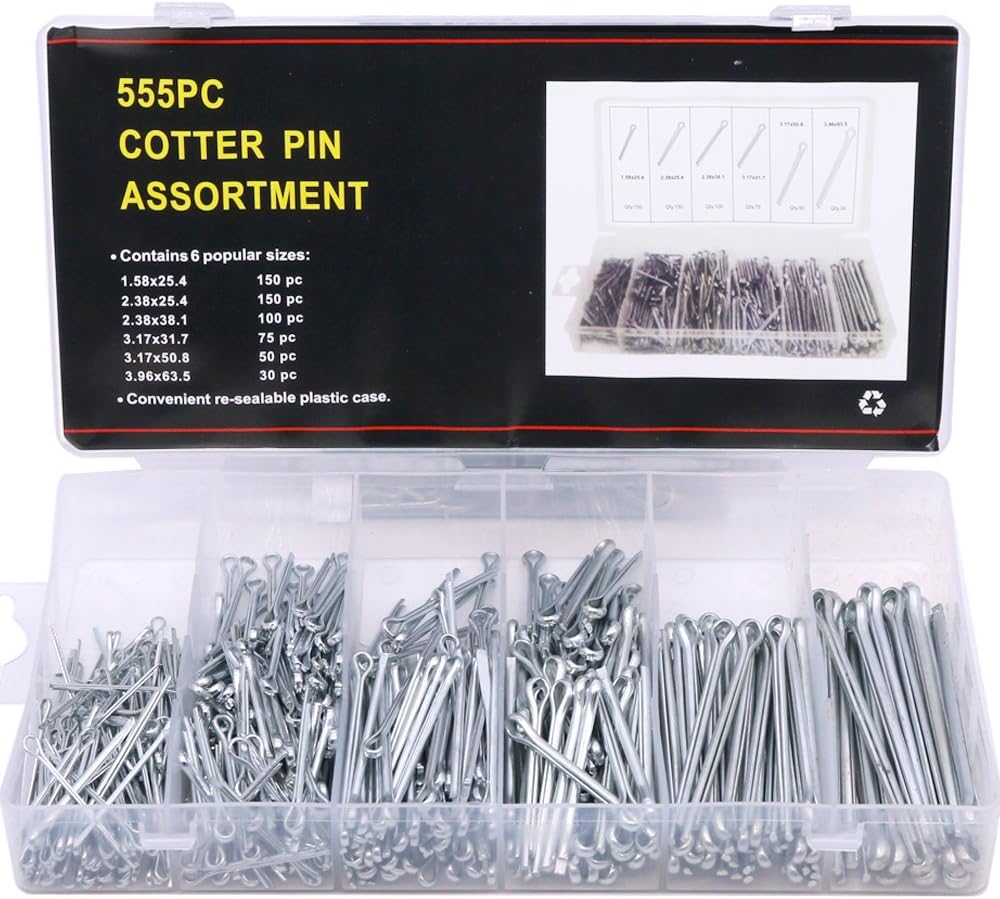
Cotter pins are simple retaining components used with compatible bolts, clevis pins, or shafts. Spring pins, also called roll pins, use their spring tension to stay in a drilled hole and can be useful where a compact retaining solution is needed. Hitch or locking pins are often chosen when fast removal and positive retention are important.
The exact design, dimensions, and included accessories vary by listing. Check each product page carefully rather than assuming that pins with a similar appearance are interchangeable.
Specifications and features to compare
Diameter and length are the first measurements to verify. The diameter must match the receiving hole or mating hardware, while the working length should pass through the required components without creating unnecessary protrusion. For headed or retaining pins, also check head diameter, head thickness, and the location of any cross-hole or groove.
Material and finish affect durability and suitability. Steel may be appropriate for general mechanical fastening, while stainless steel is often considered where corrosion resistance is important. Plated or coated finishes can provide additional surface protection, but the listing should be checked for the stated material and finish rather than inferred from appearance.
Also compare:
- Solid versus hollow or spring construction
- Headed, unheaded, grooved, or threaded designs
- Included clips, rings, washers, or retaining accessories
- Dimensional tolerances and compatibility notes
- Quantity and assortment details shown in the listing
- Whether the pin is intended for a specific tool, fixture, or assembly
A pin that fits dimensionally may still be unsuitable if its retention method, strength, or corrosion resistance does not match the application.
Fit, retention, and installation tips
Measure the existing hole and the available clearance before selecting a replacement. If a pin is used with a clip, cotter, ring, or cross-hole, confirm that the retaining part can be installed and removed without interference from nearby components.
Avoid forcing an oversized pin into a hole or substituting a loose pin where accurate alignment is required. For spring pins, use an appropriate installation method and make sure the receiving material can withstand insertion. Inspect pins used in moving or safety-relevant assemblies for bending, wear, corrosion, or deformation, and replace damaged retaining hardware rather than relying on a compromised fit.
Pins are only one fastening option. Depending on the assembly, you may also need Bolts, Nuts, Washers, or Anchors. For applications involving automated fastening, compare Collated Fasteners as well.
Brands represented in the catalog
The Pins catalog includes products from Gilliem, VTurboWay, Powertec, Glarks, T.K.Excellent, XBDZR, SNUG Fasteners, wolfcraft, Hilitchi, VIGRUE, ISPINNER, and Vandorla. Brand availability can vary by product type and specification, so compare the individual listing details, materials, dimensions, and included hardware instead of choosing by brand name alone.
For assemblies that use complementary threaded hardware, you can also compare Screws and related fastening components in the catalog.
Frequently asked questions
What are industrial pins used for?
Industrial pins can align parts, retain components, create pivot points, position fixtures, or secure assemblies. The suitable design depends on the required fit, movement, load, and retention method.
How do I determine the correct pin size?
Measure the receiving hole, the thickness of the parts being joined, and the available clearance. Then compare diameter, usable length, head dimensions, and retaining-hole placement with the product specifications.
Are all pins interchangeable?
No. Pins can differ in diameter, length, material, tolerance, head style, and retention method. A visually similar pin may not provide the required fit or holding function.
When should I choose a spring pin?
A spring pin may suit an assembly with a prepared hole where spring tension provides retention. Confirm that the pin size and installation requirements match the materials and hole dimensions.
What should I check for outdoor or damp applications?
Review the listed material and finish, and consider corrosion exposure, drainage, movement, and maintenance. Stainless or protected finishes may be appropriate when specified for the intended environment.